
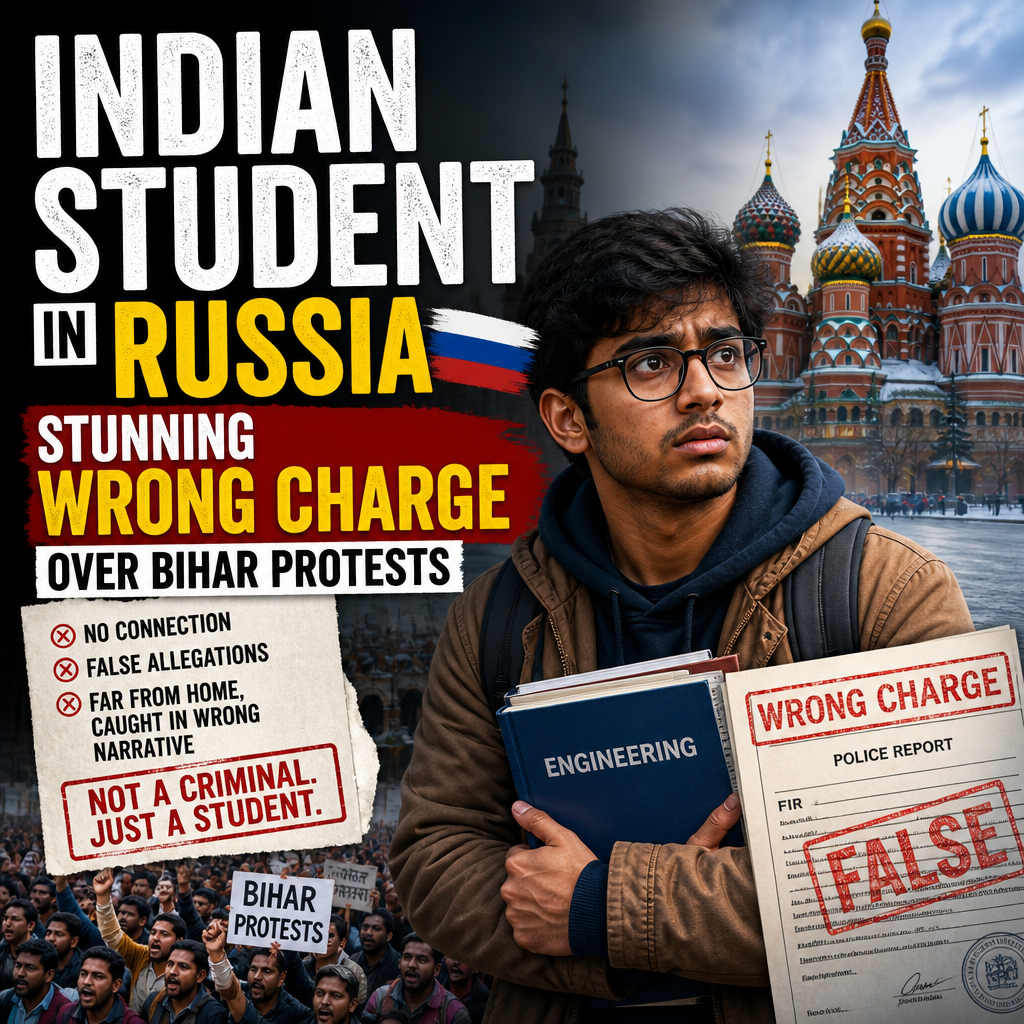
Indian Student in Russia: Stunning Wrong Charge Over Bihar Protests


Indian student in Russia has become the center of a troubling case that raises bigger questions about policing, online misinformation, and how quickly a foreign student can be swept into a political storm far from home. The basic claim sounds simple at first: a student was reportedly detained in Russia after being linked to unrest connected to protests in Bihar. But the deeper story is messier, and the available reporting suggests caution is essential before accepting the accusation at face value.
What the case appears to show
From the reporting that has emerged through international news coverage, the most important detail is not just the arrest itself but the apparent mismatch between identity and accusation. An Indian student studying in Russia was reportedly accused in connection with protest activity tied to Bihar, despite being abroad. That kind of error is not just embarrassing; it can be life-altering. For a student far from home, even a temporary detention can mean visa trouble, reputational harm, academic disruption, and a long delay in clearing one’s name.



What makes the story especially concerning is the way such cases can unfold in the digital age. If a name, image, social media post, or facial-recognition match is used carelessly, a person can be tagged to an event they had nothing to do with. In politically charged moments, the temptation to act quickly often outweighs the discipline of verifying facts first. That is where due process matters most.
The reports also point to a broader reality: students abroad are often vulnerable because they are seen through several lenses at once. They are foreigners, they may not fully understand local legal systems, and they can be easy targets if officials want a quick suspect. If the accusation is indeed wrong, the case becomes less about one mistaken arrest and more about how institutions handle uncertainty.




Indian Student in Russia: why the accusation matters beyond one arrest
There are at least three ways to read this situation, and each tells us something important.
1. The student’s perspective: a demand for basic fairness
From the student’s point of view, the central issue is straightforward: do not punish someone without proof. If the detention happened because authorities connected the student to Bihar protests on weak or incorrect evidence, then the case highlights the danger of guilt by association. A person studying abroad should not have to prove a negative simply because of nationality, online visibility, or a mistaken database entry.
That concern is reinforced by how quickly such stories can spread. In the age of social media, once an accusation is public, it can become part of a person’s identity in the public eye even if it is later corrected. For a young student, the damage can linger long after any official clarification.
2. The authorities’ perspective: security and speed can collide with accuracy
To be fair, police and security agencies often face pressure to respond quickly when protests, violence, or alleged foreign links are involved. They may argue that in fast-moving situations, preliminary detention is a routine step while facts are checked. That is not unusual in any country. The problem begins when speed replaces verification.
If the Russian authorities acted on a mistaken identity or incomplete information, then the case underscores a familiar weakness in security systems: they are often good at acting first and slower at admitting error. Even when mistakes are corrected, the correction rarely gets the same attention as the original accusation. That imbalance is part of why such cases feel so unjust.
3. The diplomatic perspective: students become symbols
India and Russia have long maintained a pragmatic relationship, and cases involving Indian nationals abroad can quickly acquire diplomatic significance. An error involving a student is not just a private legal matter; it can become a test of how carefully one country treats the citizens of another. If the allegation is false, Indian officials would have reason to seek clarity, not only for one student but for the broader assurance that citizens overseas will be treated fairly.
At the same time, governments are often careful not to overstate such incidents before the facts are settled. That restraint is wise. It avoids escalating a case that may later prove to be a misunderstanding. Still, silence can frustrate families and observers who want a firm statement. The challenge is finding the balance between caution and accountability.
Different media angles reveal the uncertainty
The value of looking across outlets like Al Jazeera, RT, and Sky News is that they rarely frame such stories in exactly the same way. Al Jazeera’s reporting tends to emphasize human impact and the risk of state overreach, especially in cases involving vulnerable individuals. RT often places more weight on official narratives and state security considerations, while Sky News commonly focuses on international implications and the human-interest element of a detention story.
Taken together, those angles do not necessarily give us a single neat answer, but they do help show where the real fault lines are:
– Was the student correctly identified?
– Was there evidence tying the student to the protests?
– Were local procedures followed properly?
– How quickly was the mistake noticed, if it was a mistake?
– What support was provided to the student after the arrest?
Those questions matter more than any instant, emotionally satisfying conclusion.
A broader warning about online accusations
This case also fits a pattern seen far beyond Russia and India. Political unrest anywhere can produce fast, sloppy attribution. A person may be misidentified from a photograph, quoted out of context, or linked to a movement because they shared something online. Once that happens, institutions sometimes act on assumptions rather than evidence.
The lesson is not just about this one student. It is about the need for a higher standard of proof when the consequences include detention, immigration problems, or public smearing. Universities, consulates, and police departments should all treat identity verification as a serious safeguard, not a formality.
The most responsible conclusion
At this stage, the fairest reading is that the case is alarming precisely because it appears to hinge on a possible mistaken charge. If that is confirmed, the student deserves a full correction, not a quiet administrative fix. If the evidence turns out to be more complicated, then transparency will matter even more.
What should not happen is a rush to turn a young student into a political symbol before the facts are clear. The story is a reminder that in international incidents, the first accusation is often the loudest—and not always the most reliable. The real test is whether institutions can slow down enough to get it right.